The Prominent Standard of Review in Correctional Liability Cases Is Objective Reasonableness
Editor's note: This article originally appeared in The Master'southward Relate; New York State Association of Chiefs of Police
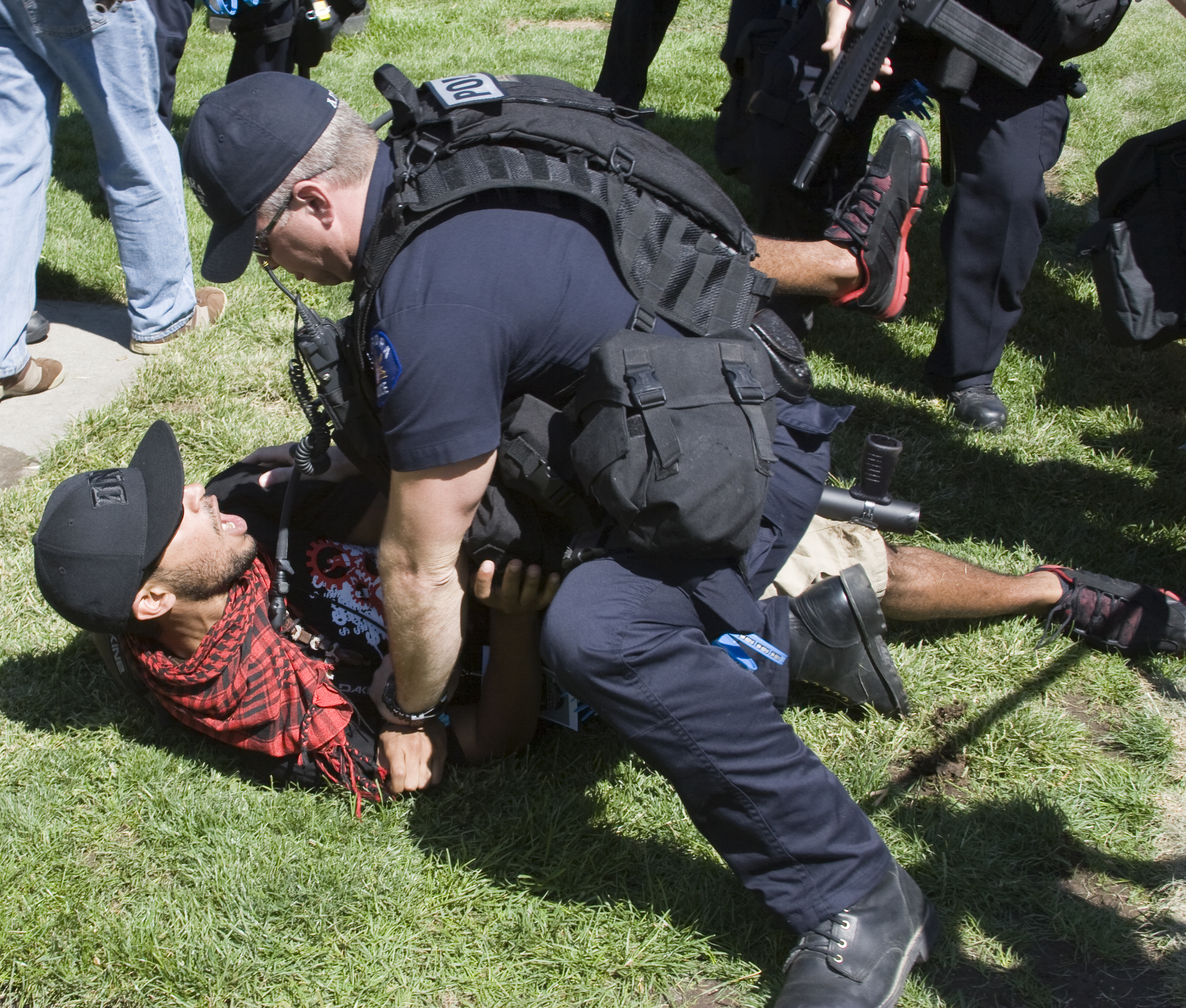
The public contend over police utilise of force continues, with some advocating legal changes. Agencies are revisiting their policies, and some are asking for public annotate. This is what the Chicago Police Department did in Nov 2016 after posting their draft revised use of strength policies. Comments posted by two law professors, Sheila Bedi and Craig Futterman, during this period volition serve as the focal point for this article.(1)
Bedi and Futterman state:
The policy should delete terms such equally "reasonably believes" or "reasonably necessary" because they are confusing and fail to provide clear guidance to officers. The policy should instead read: "The use of deadly force is a measure of last resort that is permissible only when necessary to protect against an imminent threat to life or nifty bodily injury. Every bit such, an officer may use deadly force only when such strength is necessary to prevent: (a) decease or great bodily impairment from an firsthand threat posed to the sworn member or another person, or (b) an arrest from being defeated past resistance or escape, and the person poses an immediate threat of death or great bodily harm to a sworn fellow member or another person unless arrested without delay." [emphasis added]
To the average reader, this suggested policy language may announced reasonable. But information technology is contrary to the law and completely ignores the fact that things are not always as they appear. This language assumes that human beings – police officers – will 1) immediately have all the information necessary to them to make a decision and 2) have the mental capacity under stress to make the right decision.
The linguistic communication "reasonably believes" or "reasonably necessary" flows from the Supreme Court of the U.s. and the seminal decision of Graham v. Connor.(two) The court recognized that officers need to brand split-2nd, life-or-death decisions that are not capable of precise definition or mechanical application. Such decisions are to be judged from the perspective of a reasonable officer on the scene and not with the benefit of retrospect. The objective reasonableness standard accepts the reality that officers must make the all-time call they can with whatever information is available to them, and sometimes that call will plough out to be wrong. The language proposed by the professors would reject this reality and brand officers strictly liable should they reasonably but mistakenly perceive a threat.
Human Limitations and Inadequate Training
In so many areas of our guild, we tacitly accept for granted that humans are prone to mistakes when faced with rapidly evolving situations. So why practice so many people fail to consider human being error when evaluating police use of force?
Call back about information technology: The existence of instant replay in professional football game, baseball game and basketball is an outright acquittance that humans are fallible. Even without instant replay, professional person referees and umpires already have an advantage that police officers practise non – the ability to confer and consult with each other after a phone call is made, and reverse the call if appropriate.
In that location are some who will bristle at this comparison: "The law can take a life; how can you compare that situation with a game?" But the fact that a use of force conclusion tin can have life-or-expiry consequences does not change the reality of man fallibility, especially when under stress. The question really should be, how tin nosotros place law officers in such critical situations and hold them strictly accountable for reasonable perceptions when we are surrounded in everyday life past the reality of human shortcomings?
"Merely the police force are trained to make such decisions!" Oh, really – are they? Most high school athletes volition receive more than skills grooming in their sport than most police officers will receive in their unabridged career. In New York, we requite officers about six months of bones training, which includes 40 to 48 hours of defensive tactics preparation, 48 hours of firearms training, and, depending upon the size of the bureau and/or the academy, limited scenario-based role playing and decision making. To be generous, call information technology most 140 hours of skills grooming. And so, officers graduate and face the realities of law piece of work in which those skills are infrequently used. Every bit they are perishable skills, officers may not take sufficient mastery to efficiently and finer utilise a necessary skill. If we are going to start property our officers strictly answerable, and so perhaps we need to follow the special forces model and require officers to attend an boosted 18 months of specialized preparation. This would not be a pop option in an environment where there are multiple demands upon tax dollars.
Inattention Incomprehension
During a recent NFL playoff game between the Seattle Seahawks and the Detroit Lions, Seattle had driven upward the field and was on the one-yard line. Russell Wilson floated a pass toward the back of the stop zone and receiver Paul Richardson fabricated an incredible i-handed take hold of for a touchdown.
But several things happened very quickly on this play and not everything was caught by the officials. First, the defender interfered with Richardson, for which an official threw a penalisation flag. Afterward calling the penalty, the officials then focused on what they are supposed to primarily focus on – did Richardson catch and control the ball and did he land in-bounds? The respond to these questions was yes, and the play was ruled a touchdown. What the officials did not see, however, since their attention was focused on the take hold of, was very clear in the subsequent instant replays: While Richardson was reaching out with his left manus for the brawl, his correct manus was locked onto the defender's facemask, pulling the defender's caput toward the dorsum of the finish zone. This should have resulted in a facemask penalty that would have offset the defender'southward penalty, thus negating the touchdown and resulting in a replay of the downward. The NFL rules, nonetheless, practice not allow for review of missed punishment calls in such a situation. And so, the play stood equally called.
How tin a highly-trained NFL official miss such an obvious penalisation at such a critical moment? This is likely an example of a phenomenon called "inattention blindness," which was originally discovered in 1975 and subsequently made famous past the "invisible gorilla" video.(3) In the video, six persons in 2 teams of iii were passing a basketball back and along. Squad members were dressed in either a black or white t-shirt and the subjects watching the video were instructed to count the number of passes made by the team in white. During the video, a person dressed in a gorilla suit passed through the players and pounded his chest. The typical result of this experiment is that half of the study participants exercise not come across the gorilla at all.
How tin that be? The subjects were engaged in a specific search task. Our attentional load is limited, and when faced with complex tasks or situations we must decide what to attend to and when.(4) It is not only entirely conceivable, merely it is as well predictable that NFL officials facing a complex play, with and so many different things to try to pay attention to, volition miss something. Police officers, when faced with potentially unsafe situations, have the same attentional load limitations. There is only so much that they tin "meet," and, as often happens in existent-life examples, officers tin miss things that are obvious with hindsight. To concord them strictly accountable by policy linguistic communication will not change the reality that their attentional load is limited. And this does not even have into consideration other environmental factors an officeholder may face that can affect determination making, such as inadequate lighting, inclement weather and the presence of factors known to the officer entering the situation (due east.thou., encountering a person near the scene of a "shots fired" call).
Environmental Stress
To add to the bug of limited attentional load, in that location is also the impact of stress on human being physiology. Professional umpires and referees piece of work nether periodic mild to moderate stress, but police officers involved in deadly force incidents are subject area to extreme stress.
When we perceive a threat, a complex process immediately commences in the brain, resulting in, among other things, the release of adrenaline and cortisol. This is what prepares the body for fight or flight, a response that has allowed our species to survive predatory attacks.(5) But side effects of this process tin can impede an officer'southward ability to properly perceive all available stimulus. Side effects of the fight or flying response include:
- Selective attention, also known equally tunnel vision. There will be an immediate trend to focus on the perceived threat, to the exclusion of all other stimuli. As a result, the officeholder may fail to perceive peripheral activities.
- Auditory exclusion. This is the hearing equivalent of tunnel vision. People operating in high-stress situations may hear sounds and voices as muffled or afar—or may lose hearing entirely.
- Loss of motor skills. Equally a person'south emotional arousal increases, they begin to lose their fine motor skills and, eventually, their complex motor skills, which can compromise an officer's ability to finer employ their firearm or apply some type of defensive tactic technique.
Some proponents of restricting constabulary use of force advocate that use of force policies should list situations where use of force would be strictly prohibited. Once more, this may sound reasonable, simply once you lot consider the phenomenon of inattention blindness and the human being body's reaction to stress, information technology is not realistic to await that any officer would be able to safely call up for mental review the list of prohibited situations and use that to what he or she is facing. We but do not take sufficient attentional resources to handle such demands.
Misguided Changes
Reviewing our apply of force policies is a proficient exercise, especially following incidents that draw public scrutiny. But proposals to restrict use of forcefulness policies past eliminating whatever reference to the objective reasonableness legal standard are misguided and pose a significant legal threat to officers and departments. The objective reasonableness standard exists equally an credence of the realities officers confront when involved in high-stress, use of strength encounters. Removing it volition not take the desired effect on officer's behavior. Instead, agencies should focus their time and efforts on providing the needed grooming to assistance officers make audio tactical decisions when engaging in certain incidents.
References/Notes
- Bedi, Sheila A & Futterman, Craig. Comments on the Chicago Police Section's Proposed Use of Force Guidelines. Accessed January 11, 2017.
- Graham five. Connor, 490 U.Southward. 386 (1989)
- Chabris, C. & Simons, D. (2010) The Invisible Gorilla: How Our Intuitions Deceive Us. New York, Crown Publishing Group.
- For a discussion of attention, more often than not: Schmidt, Richard A. and Lee, Timothy D. (2014) Motor Performance and Learning, 5th Edition. Champaign, IL: Human Kinetics, Chapter 3.
- This article is merely intended to exist an overview of the relevant problems pertaining to the response to stress. For a general overview, run across chapters 1 and 2 of: Sharps, Thousand. (2010) Processing Under Pressure: Stress, Memory and Conclusion-Making in Law Enforcement. Flushing, NY: Looseleaf Constabulary Publications, Inc. There are too numerous other sources on the topic and some tin can be find through the Force Science Constitute website.
Source: https://www.lexipol.com/resources/blog/police-use-of-force-need-objective-reasonableness-standard/

Yorum Gönder for "The Prominent Standard of Review in Correctional Liability Cases Is Objective Reasonableness"